In dit artikel
- A ransomware group leaks files linked to Visa, Mastercard, and JPMorgan Chase customers
- The data may include emails, phone numbers, and travel or dining bookings; no card numbers have been reported exposed
- Scammers could use personal details to make their messages more convincing
Customer information linked by researchers to Visa, Mastercard and JPMorgan Chase has appeared after cyberattacks on third-party service providers. The companies report no impact to their payment networks.
On November 19, the companies acknowledged incidents involving third-party providers. JPMorgan told Reuters:
“Based on our investigation so far, we believe the attackers accessed certain marketing data held by those vendors, which may include some customer names and email addresses.”
But “no payment data” doesn’t mean “not useful to criminals.” Knowing your name, email address and which financial services you use can give a scammer a convincing opening line.
Visa said it was aware of the claims and that they were associated with an incident involving a third-party service provider in Asia-Pacific. Mastercard said an incident at a third-party provider exposed a limited number of email addresses associated with a particular card-benefit program.
Cybernews researchers say similar formatting suggests the data came from the same third-party provider. The provider and its role haven’t been identified, but it may handle card benefits such as dining, reservations, or loyalty programs, rather than payment processing. The leaked records appear to relate to those extra services.
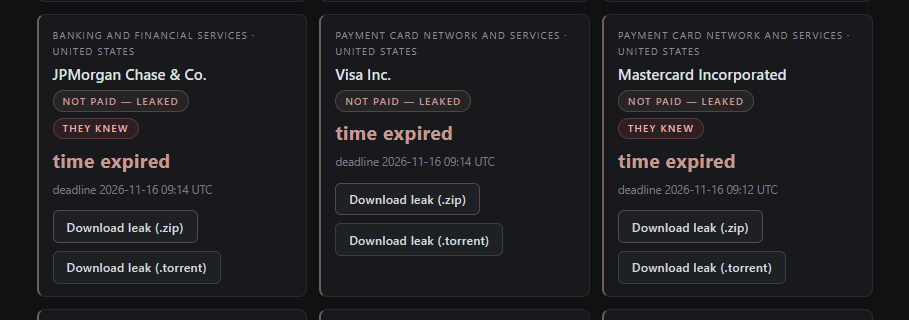
A ransomware group calling itself n0n has claimed responsibility and published data it says it stole.
What information was exposed?
The answer depends on the company and on whether we are talking about company disclosures or researchers’ analysis of the purported stolen files. The leaked data has not been independently verified.
The companies have disclosed the following:
- JPMorgan Chase: Marketing data held by vendors, potentially including some customer names and email addresses.
- Visa: An incident at an Asia-Pacific service provider. Visa says its systems were not affected and there is no indication that payment data, such as card numbers, was affected.
- Mastercard: A limited number of email addresses belonging to a small subset of cardholders enrolled in a specific benefit program. Mastercard described this as non-payment information.
The n0n leak site lists JPMorgan Chase, Visa, and Mastercard and claims their data was published after the ransom deadline passed on November 16.
Researchers at Cybernews reported additional details from the leaked datasets:
- JPMorgan: Roughly 16,000 customer email addresses, some phone numbers, identifiers described as account IDs, and more than 100 employee email addresses.
- Visa: A dataset involving more than 6,000 premium customers, with fields including names, email addresses, phone numbers, messaging-app information, and booking details such as dates and addresses.
- Mastercard: Data posted by n0n includes marketing information related to customers in North America, the Middle East, and Africa, and a small number of Mastercard employee email addresses, according to Reuters.
Hoe u uw accounts kunt beveiligen
If you’re concerned your information may be involved, these steps can help protect your accounts and identity:
- Verify messages independently. Open your bank’s official app, use a website address you already know, or call the number on your card or statement. Do not use a link or phone number supplied by someone claiming to be investigating the breach.
- Never read out a login or payment-verification code to an unexpected caller. Those codes can be the missing piece that allows a criminal to access your account. Enter them only when completing an action you initiated through the genuine service.
- Do not transfer money to “protect” it. A caller who tells you to move your savings into a “safe account” is trying to steal them. Hang up and contact your bank independently.
- Verify any offer of breach support before enrolling. JPMorgan says it will contact affected customers where appropriate and offer support, including complimentary credit monitoring.
- Consider a credit freeze as a separate identity-protection measure.
- If you’re unsure whether a message is a scam, use Malwarebytes Scam Guard. It’s free and can help you assess the message and decide what to do next.
If your data was involved in a breach, read our guide for more advice: Involved in a data breach? Here’s what you need to know.

Wat weten cybercriminelen over jou?
Gebruik Malwarebytes 'Gratis digitale voetafdrukscan om te zien of uw persoonlijke gegevens online openbaar zijn gemaakt.