It’s the most wonderful time of the year, especially for scammers.
The holiday shopping season is packed with tempting one-day-only deals, gift guides, and retailers promising the perfect present at the perfect price.
And wherever shoppers go, scammers aren’t far behind.
Cybercriminals have always taken advantage of the holiday rush. Now AI makes it easier to create fake storefronts, products, reviews, and promotions that look and sound legitimate. For consumers, knowing what—and who—to trust is getting harder.
Shoppers are worried. According to Malwarebytes research, 77% of consumers are concerned about being scammed by a retailer using a fake AI website, or using AI to misrepresent products or reviews.
That concern is grounded in experience: More than one in four consumers (28%) have experienced an AI-related shopping scam in the past year Some were misled by AI-generated product photos or reviews. Others described ordering products that never arrived, sometimes from legitimate-looking websites that turned out to be fake.
With the holiday shopping season upon us, we’re looking at how AI is changing the shopping experience, where consumers see risks and benefits, and how to shop more safely.
When a great looking product isn’t what it seems
Realistic product images, glowing reviews, and professional-looking websites can make unfamiliar retailers seem trustworthy. AI makes it easier to create all three in one polished package, which is convincing enough to deceive even careful shoppers.
For some, these convincing fakes have made buying online feel unsettling. One survey respondent commented:
“It seems as though when I’m shopping online, I notice the models are AI-generated or even the products themselves and that scares me. I can’t tell what’s real or not anymore. I don’t even know if what I’m looking to buy is real! I don’t know if what is being advertised is the actual product. AI is going too far.”
Survey respondents shared real-life experiences that help explain those fears. One described receiving products that looked nothing like the photos:
“I buy fewer items that I don’t already know from real life because I fell for manipulated images and the delivered items barely resembled the edited pictures in the shop!”
This aligns with what we’re seeing too. As an example, earlier this year we found cat face flower seeds being sold online.

But manipulated images don’t have to look this extreme, or this obvious. As AI improves, telling what’s genuine from what’s fake is getting much more difficult.
Some of our survey respondents described seeing convincing fake storefronts that took their money without delivering anything:
“It was a fake website promoting shoes. I bought them and it turned out to be an AI website. Now I’ll be more wary of these websites and what they look like.”
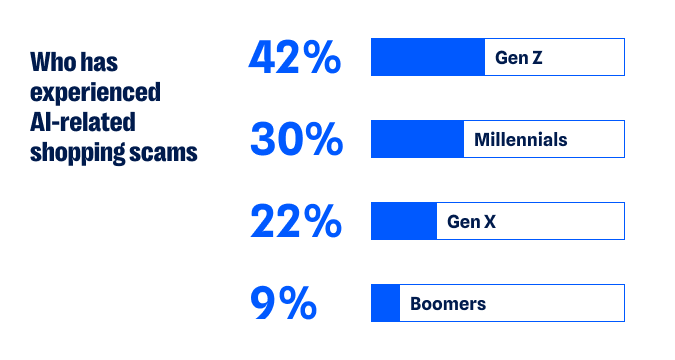
These experiences are especially common among younger shoppers. 42% of Gen Z say they’ve experienced an AI-related shopping scam, compared with 30% of Millennials, 22% of Gen X, and just 9% of Boomers and older.
The impact goes beyond lost money or a missing package. Respondents described feeling embarrassed, angry and unsettled by how convincing the deception was. For many, that experience left a lasting distrust of online retailers.
How AI brings scams directly to shoppers
Scammers don’t have to wait for shoppers to stumble across a fake website. With the help of AI, they can send convincing, personalized messages that appear to come from familiar brands, bringing scams directly to consumers.
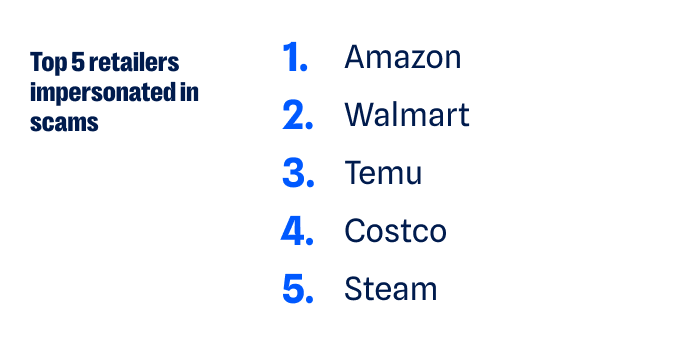
It’s no wonder that global mega-retailer Amazon is the most impersonated brand that we see in our threat intelligence data, followed by Walmart, Temu, Costco, and Steam.
Scammers are getting personal
Nearly one in four consumers (24%) say they’ve received a scam message that felt highly personalised, sometimes including their name or other personal details. Among Gen Z, that figure rises to almost one in three (32%).
We came across a scam that linked a person’s phone number and name with a fake Facebook Marketplace listing to act as a conversation lure and get them to respond. Answering a message is often the first step in what can become a very costly scam.
Even when shoppers spot the warning signs, a personalised scam can leave them feeling uneasy. One respondent explained:
“I received an email that was clearly directed to me personally, yet it seemed “off” which was an alarm for me. I investigated it before clicking on anything and knew then that it was a scam. It made me feel like nothing is safe out there anymore and you have to be hyper-alert at every moment when online.”
Spotting scams among the shopping noise
Delivery companies are an obvious choice for scammers to impersonate at this time of year. With more purchases being made, it can be hard to keep track of which retailer is using which delivery service, and on which date it will arrive.
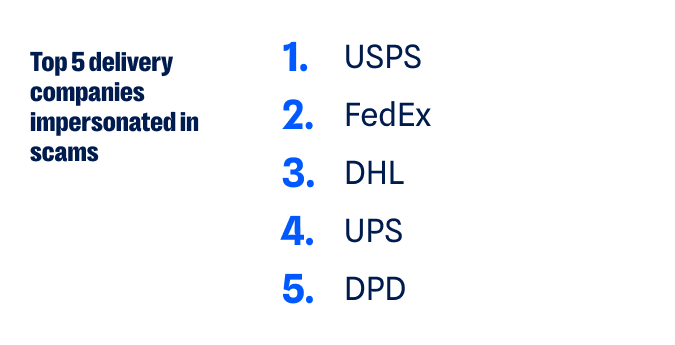
Common delivery scam lures we’ve seen include:
- A delayed parcel notification, paired with a request to pay a small fee through a link
- A failed-delivery claim demanding address confirmation or rescheduling.
- Short deadlines or “final notice” language to create a sense of urgency.
- Lookalike delivery company domains and off-brand links.
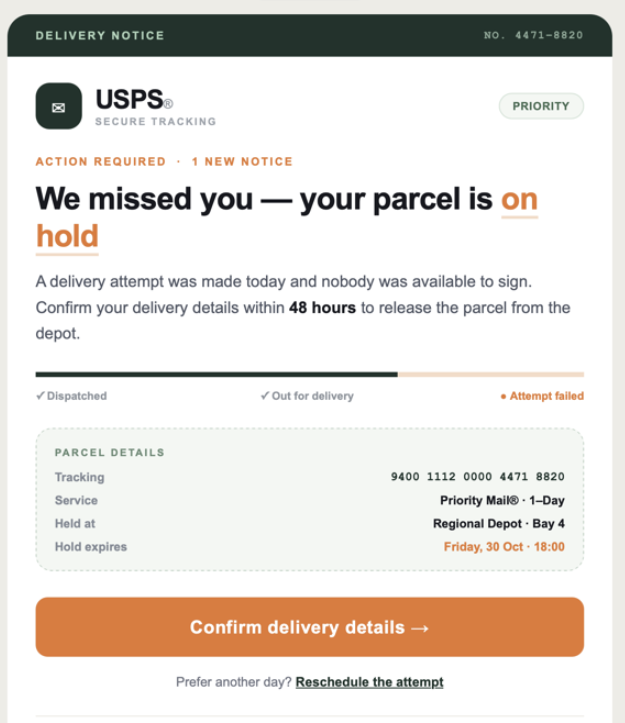
In this example, scammers use a fake missed delivery, the USPS brand, and a sense of urgency (48 hours) in order to get their target to click.
The broader research shows just how challenging this environment has become:
- 85% agree that sophisticated scams can be hard to distinguish from the real thing
- 85% believe AI makes it easier for scammers and criminals to target people
Even the most routine messages about purchases and deliveries warrant a closer look, and that’s one more thing for consumers to worry about during an already busy time of year.
Where shoppers accept AI
Despite their concerns, many consumers accept some uses of AI in retail. In the survey, 43% say it’s okay for businesses to use AI-generated websites to sell products, while 36% accept AI-generated salespeople. Including neutral responses, those figures rise to 72% and 64%, respectively.
There’s also growing acceptance of AI on the retailer side. 43% say it’s okay for businesses to use AI-generated websites to sell products, while 36% are okay with AI-generated salespeople. Including those who feel neutral about these practices, the figures rise to 72% and 64%, respectively. That shows how willing consumers are to let AI into the shopping process, despite their concerns.
That acceptance extends to product images: 60% say using AI to enhance them is no different from existing advertising practices. Product photos have long been staged, edited and polished to make merchandise look its best; AI can do the same.
Shoppers’ responses show that concern about AI and acceptance of its use can coexist. In the holiday rush, distinguishing a useful shopping aid from a convincing deception can be difficult.
Shoppers are taking precautions, but the burden is growing
Some shoppers are responding in practical ways, starting with where they choose to buy:
- 36% have limited purchases from unfamiliar online retailers.
- 26% have limited purchases from social media accounts
As one respondent explained:
“I am more wary of purchasing something from an ad I see on social media. I tend to search for the item online myself and find a legit website to order from.”
Others are checking information more carefully:
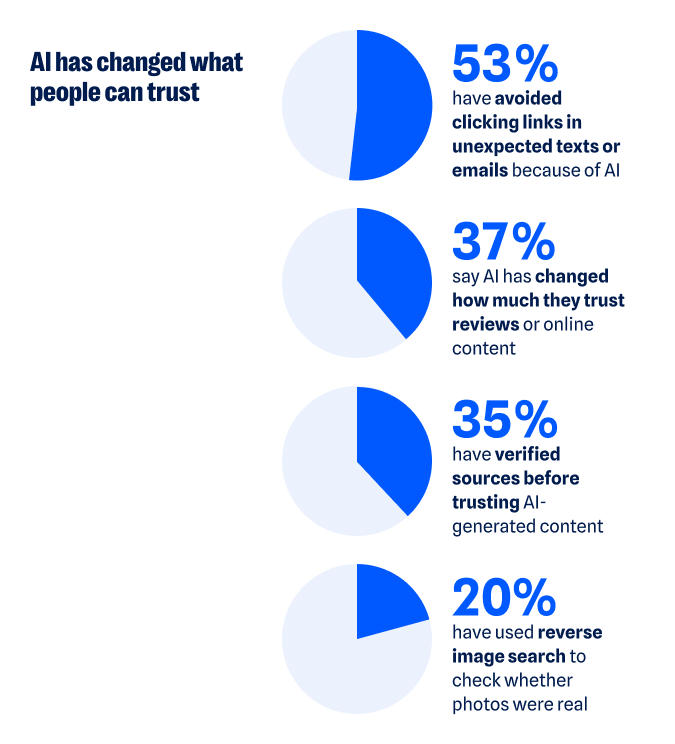
One respondent described checking reviews on another website after watching a convincing product video on social media, only to uncover signs of a scam. Another now deliberately seeks out negative or neutral reviews and real customer photos. Others describe comparing information across multiple sources rather than taking any online content at face value.
One respondent summed up the need for extra caution:
“I tell my children not everything that glitters is gold. Always be careful and check everything yourself. With AI today you can make everything look beautiful but beautiful doesn’t mean true, correct or authentic. Fact checking is the order of the day.”
Beyond checking information for themselves, consumers also value having another person to turn to when they need help. Nearly seven in ten (69%) say they’d spend extra time or pay more for human customer service, while 43% say they’ve tried to talk to a real person rather than an AI customer service system.
AI may make shopping more convenient for some, but that doesn’t mean consumers want to rely on it for every interaction.
How to spot AI-powered shopping scams this holiday season
AI can make fake stores, product photos, and reviews look extremely convincing. Here are four ways to protect yourself:
- Slow down. Scammers use urgency to rush you. During the holidays, limited-time deals and delivery alerts can be especially persuasive. Don’t let a countdown or unexpected message stop you from checking first.
- Guard your information. Be wary of unexpected requests from sellers or delivery services for passwords, payment details, or other personal information. A message can use your name or mention a recent purchase and still be fake. You can check which data
- Verify the source. Check independent reviews and compare product photos and details across websites. Go to the retailer’s official site directly instead of following links in messages. Remember that logos, email addresses, and caller IDs can all be faked.
- Use anti-scam/scam detection tools. Malwarebytes offers free tools to help you spot and stop potential scams. If you’re worried about the legitimacy of a DM, text, email, link, or number, upload it to Scam Guard. We’ll give you a verdict on whether it’s safe, along with guidance on what to do next. You can also use Browser Guard as you shop to block scammy and fraudulent websites, and stop card skimmers in their tracks.
Sobre a pesquisa
The research in this article is based on a March 2026 survey about AI, identity, and digital trust, conducted among 1,500 respondents in the United States, United Kingdom, Germany, Austria, and Switzerland. The research was prepared by an independent research consultant and distributed via Forsta.
Algo parece errado? Verifique antes de clicar.
Malwarebytes Scam Guard ajuda você a analisar links, textos e capturas de tela suspeitos instantaneamente.
Disponível com Malwarebytes Premium Security para todos os seus dispositivos e no aplicativo Malwarebytes para iOS e Android .