One of Malwarebytes’ managers recently received a call from scammers pretending to be a document delivery service.
The voicemail sounded official:
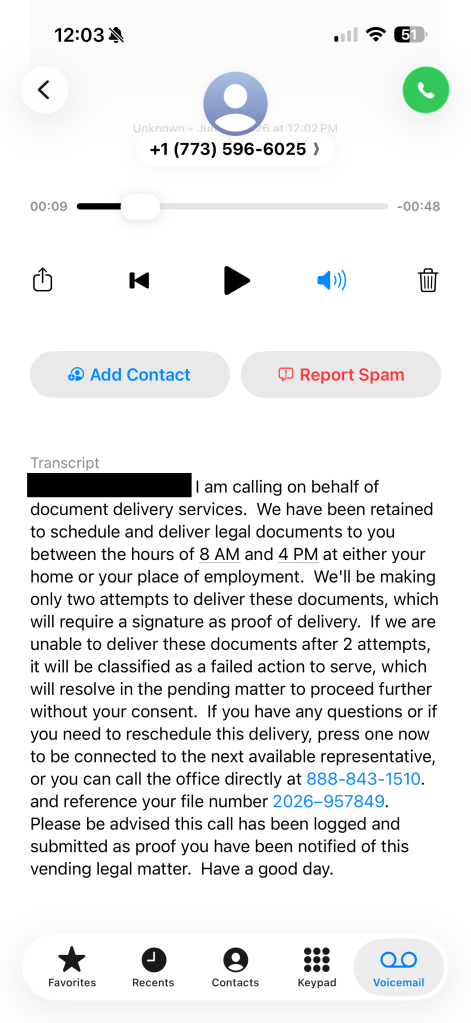
“I am calling on behalf of document delivery services. We have been retained to schedule and deliver legal documents to you between the hours of 8 AM and 4 PM at either your home or your place of employment. We’ll be making only two attempts to deliver these documents, which will require a signature as proof of delivery. If we are unable to deliver these documents after 2 attempts, it will be classified as a failed action to serve, which will resolve in the pending matter to proceed further without your consent. If you have any questions or if you need to reschedule this delivery, press one now to be connected to the next available representative, or you can call the office directly at 888-843-1510 and reference your file number 2026-957849. Please be advised this call has been logged and submitted as proof you have been notified of this pending legal matter. Have a good day.”
The goal is to scare you into calling back and handing over personal information, or even money.
Red flags
There are several clues that give this scam away:
- The caller ID doesn’t add up. The call may appear to come from a local number, while the callback number is a toll-free 888 number. Scammers sometimes spoof phone numbers to make calls appear local and trustworthy. If you try to call the number that is listed as the “caller,” you may find it doesn’t exist.
- The company name is vague. “Document delivery services” isn’t the name of the company. A legitimate company would have mentioned their name, or at least the party they are representing.
- The legal language is carefully crafted to create panic. Terms like “failure to serve,” “pending matter,” and “proceed without your consent” are all designed to create anxiety, leading targets to assume they’re facing legal action or arrest.
What are they after?
What’s worrying is that scammers often already know some of your personal information, such as your name and telephone number. They use the call to try to gather more information, like asking for your physical address and other personal and payment information.
People who called the number reported that the scammers asked them to “verify” personal details. They then claimed the victim owed money on an old debt or unpaid charge and offered a discounted settlement if payment was made quickly.
According to complaints filed with the Better Business Bureau, some victims reported losses ranging from $100 and $500.
Several people also reported that the scammers became angry when victims questioned them or refused to provide personal details.
How to stay safe
Recognizing scams is the best way to avoid becoming a victim.
If you receive a call like this:
- Stay calm. Scammers always try to rush you into decisions before you can think them through. Legitimate organizations don’t usually demand immediate action, threaten arrest over the phone, or pressure you to make quick payments.
- Don’t be afraid to ask for help. Anyone can be caught off guard by a convincing scam. If you’re unsure, talk it through with someone you trust or use Malwarebytes Scam Guard, which identified this as a scam and can explain what to do next.
- Don’t call back numbers provided in unsolicited messages. If someone claims to represent a company, law firm, or government agency, look up their contact details independently and verify the claim yourself.
- Never share personal or payment information unless you’re certain who you’re dealing with. Even if the caller already knows some details about you, that information may have come from a data breach, public records, or other sources.
- Finally, make yourself a harder target. Avoid posting your phone number publicly on social media or websites where it can be collected by scammers and data brokers.
Something feel off? Check it before you click.
Malwarebytes Scam Guard helps you analyze suspicious links, texts, and screenshots instantly.
Available with Malwarebytes Premium Security for all your devices, and in the Malwarebytes app for iOS and Android.