While digital billboards are supposed to grab your attention, recent reports from Egypt, Malaysia, and Brazil described them doing so with explicit footage.
The cyberattacks were claimed by a group called Leakers$, which said it exploited software used to send content to LED displays.
The group said it did not hack into individual billboards to show the pornographic footage, but that it accessed the software used to send the content.
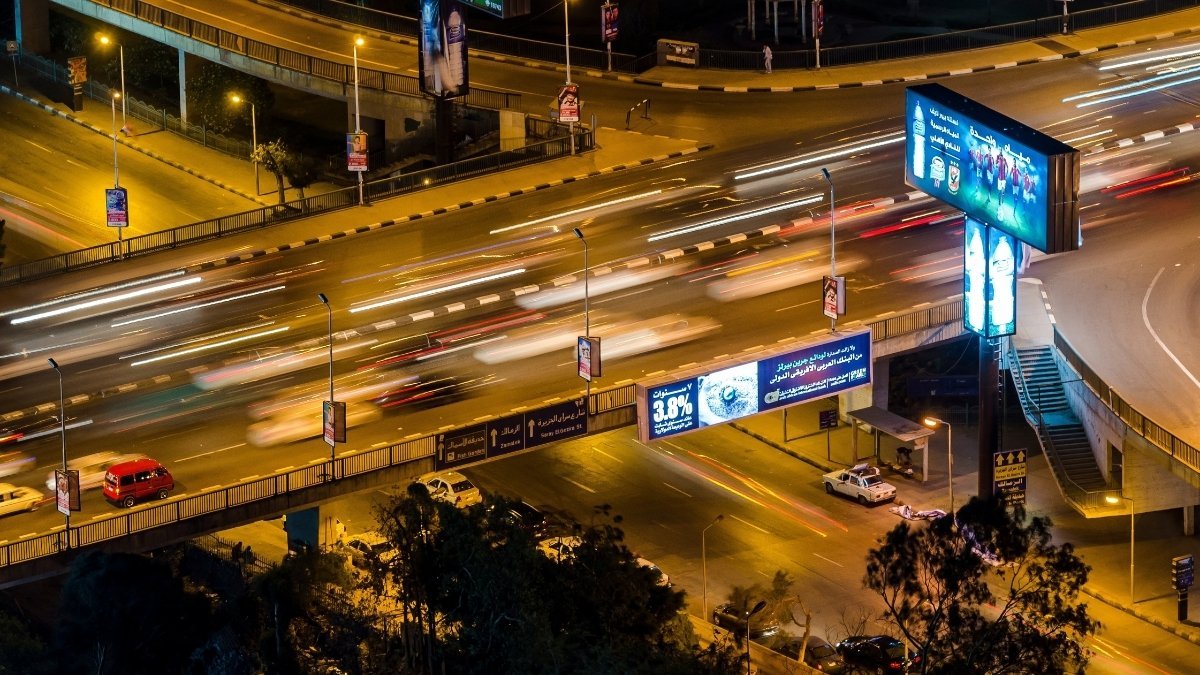
For example, on October 29, explicit footage appeared on a large billboard overlooking one of Egypt’s busiest highways. Videos circulating online showed the attackers’ aliases and a Telegram channel address overlaid on the footage. Some motorists stopped to record it.
Egyptian authorities said the billboard’s operator suffered a website compromise, resulting in unauthorized footage appearing in several countries simultaneously. Similar events were reported in Malaysia and Brazil. The attackers also claimed access to systems in Iraq and China, but those claims are less firmly corroborated.
Speaking to The Cairo Report, a representative of Leakers$ claimed the group found thousands of exposed systems during roughly two hours of automated scanning. The representative described a vulnerability in content-transmission software and weaknesses accessible through the systems’ own web pages and interfaces.
That is the group’s account, but if it is accurate, it helps explain the apparent ease and reach of the attack:
- Internet exposure makes targets discoverable. Attackers can scan for reachable management systems rather than physically approach individual screens.
- Repeated software weaknesses can scale. Finding a flaw in software used across multiple installations can create opportunities far beyond one billboard.
- Content-management access is the prize. Someone who gains control of the system that publishes advertisements may be able to replace legitimate content without touching the display itself.
This is another example of how convenient remote management can expose systems to attack. Recent attacks on refrigerated systems in European supermarkets demonstrated a similar risk. The cooling systems are internet-connected, so mechanics can remotely diagnose and fix problems.
What should be done
The risk of food waste or dangerous traffic situations should be a warning to review what organizations need to do to prevent their systems from being hacked and abused.
Regarding digital billboards, the Out of Home Advertising Association of America’s security guidelines tell operators not to rely on manufacturers’ default passwords or reuse passwords across displays. They also recommend restricting access to management services, using multifactor authentication, and protecting remote connections with a VPN.
But the practical response is less about protecting a giant television and more about securing a remotely managed computer system:
- Restrict management access rather than leaving it open to the public internet.
- Replace default and reused passwords and enable multifactor authentication.
- Keep signage software, controllers, and networking equipment updated.
- Check who has access, including suppliers, and how that access is protected.
- Monitor systems and rehearse a way to stop unauthorized access quickly.
These same basic rules can be applied to smart household appliances.
What do cybercriminals know about you?
Use Malwarebytes’ free Digital Footprint scan to see whether your personal information has been exposed online.