The Federal Bureau of Investigation’s (FBI) Internet Crime Complaint Center (IC3) is warning that scammers are impersonating the bureau on social media and on messaging apps, targeting people who’ve already been victims of cybercrime.
The FBI has issued warnings like this before, but scammers posing as IC3 employees and FBI agents continue to evolve their schemes and claim new victims.
The best-known of these scams are recovery scams, complete with FBI logos and branding that make them look far more convincing.
Facebook accounts like the one below—and yes, I reported it—with equally fake reviews prey on people who have already fallen victim to a scammer.
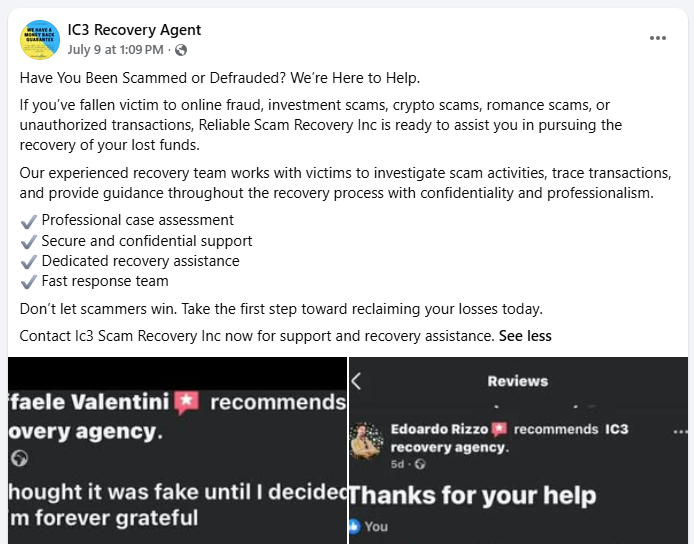
“Have You Been Scammed or Defrauded? We’re Here to Help.
If you’ve fallen victim to online fraud, investment scams, crypto scams, romance scams, or unauthorized transactions, Reliable Scam Recovery Inc is ready to assist you in pursuing the recovery of your lost funds.
Our experienced recovery team works with victims to investigate scam activities, trace transactions, and provide guidance throughout the recovery process with confidentiality and professionalism.
Professional case assessment
Secure and confidential support
Dedicated recovery assistance
Fast response team
Don’t let scammers win. Take the first step toward reclaiming your losses today.
Contact Ic3 Scam Recovery Inc now for support and recovery assistance.”
The scammers count on victims feeling desperate and embarrassed. They have no scruples about victimizing them all over again.
The post contains a lot of the tell-tale signs IC3 warns about. Very vague but reassuring claims: “experienced recovery team,” “professional case assessment,” “secure and confidential support” all sound impressive but provide no verifiable detail. High‑level promises like “investigate scam activities” and “trace transactions” imply special legal or technical powers, but the FBI warns that scammers make similar promises to convince victims they’re dealing with authorized investigators.
Besides setting up fake IC3 accounts, they also monitor social media for posts from victims saying they’ve reported a scam to the FBI, then swoop in posing as FBI follow‑up contacts.
If victims remain unconvinced, the scammers may create videos depicting senior FBI officials or other recognizable public figures urging them to submit their case through a specific link “to speed up recovery.” The FBI says criminals are increasingly using AI-generated deepfake audio and video to make these messages appear genuine.
How to stay safe
First and foremost, remember that IC3 has no official social media presence, does not investigate crimes via social media, and will never contact victims directly to recover funds.
As the IC3 homepage states:
“The IC3 does not work with any non-law enforcement entity, such as law firms or crypto services, to recuperate lost funds or investigate cases. The IC3 will never directly contact you for information or money.”
So, if an “agent” appears in your direct messages (DMs) right after you post publicly about being a crime victim or planning to report to the FBI, assume they are a scammer until independently verified. A few other tips:
- Never pay upfront: Legitimate government agencies never ask you for advance payment to recover stolen money.
- Ignore unsolicited claims: Be highly suspicious of anyone who reaches out to you out of the blue claiming they can reverse a previous scam.
- Never share your credentials: Do not give remote access to your device or hand over your passwords and recovery phrases to unknown third parties.
- Don’t provide IDs or financial information. Scammers can use them for identity theft or further fraud.
- Use verification tools: If you receive a suspicious email, message, or phone call, you can verify its legitimacy using tools like Malwarebytes Scam Guard.
- Report scammers: If you or someone you know has fallen victim to this scam, file a complaint with the IC3 at ic3.gov.
Something feel off? Check it before you click.
Malwarebytes Scam Guard helps you analyze suspicious links, texts, and screenshots instantly.
Available with Malwarebytes Premium Security for all your devices, and in the Malwarebytes app for iOS and Android.