What you need to know
- Quantum computing uses qubits that can represent multiple states at once, allowing these machines to solve problems far more efficiently than classical computers.
- It’s based on quantum physics principles like superposition, entanglement, and interference, which enable massive parallel processing.
- Quantum computers excel at complex tasks such as simulating molecules, optimizing logistics, and developing new materials – areas where traditional computers struggle.
- Leading companies like Google, IBM, Microsoft, and Amazon are racing to build practical quantum systems, with real hardware already accessible via the cloud.
- While still experimental, quantum technology is rapidly progressing, with potential breakthroughs expected in the next 5–10 years.
Quantum computing could reshape industries, from healthcare to cybersecurity – even if you never use one directly, the impact will reach you. tion. Then contact your bank’s fraud department.
What is quantum computing?
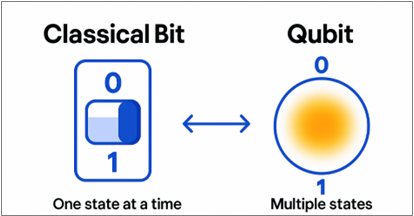
Quantum computing is an advanced form of computing based on the principles of quantum physics (the science of how tiny particles like atoms behave). While ordinary bits can be 0 or 1, quantum computers use quantum bits (qubits) which can be both 0 and 1 at the same time.
This allows quantum computers to handle enormous amounts of information and explore countless possible solutions all at once. They can tackle problems in areas like chemistry and logistics that would take classical computers millions of years to solve.
What is quantum computing explained in simple terms?
It can be tough to get your head around. Try to think of quantum computing like trying every possible answer to a difficult question all at the same time, rather than one by one. It does this by using particles that can hold multiple states at once. This happens due to a weird property of quantum physics called superposition, which we’ll explain in more detail below.
It’s not magic. It is very smart physics. By harnessing complex phenomena like entanglement, quantum computers can process complex data in parallel. This offers new possibilities for solving some of the world’s hardest problems.
How does quantum computing work?
Quantum computing is powered by the odd and surprisingly powerful behavior of particles so small you can’t see them. To really grasp what’s happening, you have to dip into a few key ideas from quantum physics. Those unusual rules are what give quantum computers their edge, letting them tackle complex problems far quicker than the machines we use today.
Superposition
As mentioned earlier, superposition is one of the key reasons quantum computers can do what they do. It allows a qubit to be in a state of 0, 1, or — and here’s the twist — both 0 and 1 at the same time. A traditional bit can only pick one, but a qubit doesn’t have to choose.
With that ability, a quantum computer can check countless possibilities at once. Imagine working on a massive puzzle: a classical computer tests one piece at a time. A quantum computer behaves as if it’s trying every piece in every spot at the same moment, turning huge, time-consuming challenges into something far more manageable.
Behaviour of a Quantum Computer
Entanglement
Entanglement is a strange quantum effect where two or more qubits become connected in such a way that they act like a single system. Once linked, they stay linked, no matter how far apart they are — across a lab or across the planet. Change the state of one, and the other reacts instantly.
This connection lets qubits share information and work together in ways classical bits simply can’t. The result? They can tackle problems much faster and more efficiently, acting less like individual pieces and more like parts of one coordinated, powerful machine.
Interference
Quantum computers rely on the wave-like nature of particles. Just as waves can amplify or cancel each other out, quantum states can do the same through interference.
Interference allows quantum algorithms to (proverbially) nudge the computer toward the right answers and away from the wrong ones. That interference can be controlled so quantum computers increase the chances of the correct solution emerging when the final measurement is taken.
Decoherence
One of the biggest headaches in quantum computing is something called decoherence. Think of a quantum state as a soap bubble–beautiful, delicate, and gone in an instant if you poke it. Even the faintest noise or tiny bit of interference from the outside world can pop it.
When that bubble bursts, the information inside the qubits collapses and the whole calculation falls apart. To stop this from happening, scientists are working on ways to seal qubits off from their surroundings and building clever error correction tricks to keep them stable just long enough to get a useful answer.
Quantum vs. classical computing
Classical computers are great at everyday tasks like opening apps, streaming videos, browsing the web. They’re built for that kind of general-purpose work and handle it with ease.
Quantum computers, on the other hand, come alive when the problems get wildly complicated. When there are mountains of variables and endless possibilities to sort through, they can find answers in a fraction of the time. The kind of problems that might keep a classical computer busy for centuries.
Classical computing
Classical computers use bits in the traditional way. These are the familiar building blocks of modern computing. As referenced earlier, each bit can be in one state at a time, either 0 or 1. This simple system powers everything from your phone to the most advanced supercomputers.
Classical computers work by performing calculations step by step, following logical instructions to reach an answer. They process data in a linear fashion and are incredibly reliable for tasks like spreadsheets and even gaming, due to this processing system.
But as problems get more complex, especially ones with many possible solutions, classical computers struggle because they must check each option one after another.
Quantum computing
We’ve explained that quantum computer bits can be both 0 and 1 simultaneously, because of superposition. This allows quantum computers to test many possible solutions at the same time, making them ideal for certain types of complex problems.
These computers leverage the parallel nature of quantum mechanics. It is like lifting up 10 rocks at the same time to see what is underneath whereas a traditional computer has to do it one at a time.
Quantum computers are not faster for everything. They’re designed to complement classical machines.
Where quantum computers have an edge
Quantum computers have moved past theory, they’re already being tested in real-world scenarios. In certain situations, they’re proving to be far better suited than traditional machines.
One exciting area is simulation. Quantum computers can mimic the behavior of atoms and quantum materials in ways classical computers simply can’t pull off. That opens the door to breakthroughs in fields like chemistry and physics, from designing new forms of matter to creating better ways to store energy.
Optimization is one area where quantum computing could be a real game changer. Many everyday challenges – from plotting the fastest delivery route to balancing an investment portfolio – boil down to sifting through endless possibilities to find the best one. Quantum algorithms can juggle all those variables at the same time, spitting out an optimal solution in moments.
Cybersecurity is another big one. A powerful enough quantum computer could tear through traditional encryption in no time. But the story isn’t all doom and gloom – the same technology can help create quantum-safe cryptography. That’s why tech companies are already racing to roll out new security standards built for the quantum age.
Then there’s medicine. Quantum simulations can model how molecules interact at an incredibly detailed level, helping scientists discover new drugs or materials faster. The payoff could be huge: breakthrough treatments reaching patients years sooner than with today’s methods.
What does a quantum computer look like?
Quantum computers don’t look anything like the laptops or servers we use today. They’re usually large, complex machines housed in temperature-controlled environments designed to keep them as stable as possible.
At the heart of many quantum systems is a tall cylindrical device called a cryostat. This chamber cools the quantum processor to temperatures near absolute zero (colder than outer space) because qubits must operate in ultra-low energy states to maintain quantum behavior.
Surrounding the quantum chip are layers of wiring, control electronics, and classical computers. The classical systems help prepare and measure the quantum states.
Since these machines are large and delicate, most users access them through the [cloud]( https://www.malwarebytes.com/what-is-the-cloud), not by owning or operating them directly. For now, quantum computing remains firmly in the world of specialized labs and cloud services, not consumer desktops.
How far along is the quantum computing technology?
Quantum computing is not just a theoretical concept. Real quantum computers exist today. It should be noted that the technology is still in its early stages, and we are likely several years away from quantum computers being widely useful for everyday applications. A McKinsey study predicted that 5,000 quantum computers will be operating by 2030.
Most current quantum computers are experimental and operate in specialized research labs. These early systems typically have just a few hundred qubits. They require extreme environments to function and must be kept in super-cold temperatures close to absolute zero. Don’t expect them to be available from stores any time soon.
One of the biggest challenges is error correction. As explained earlier, qubits are extremely sensitive to noise and interference so today’s quantum computers still struggle with reliability and scale.
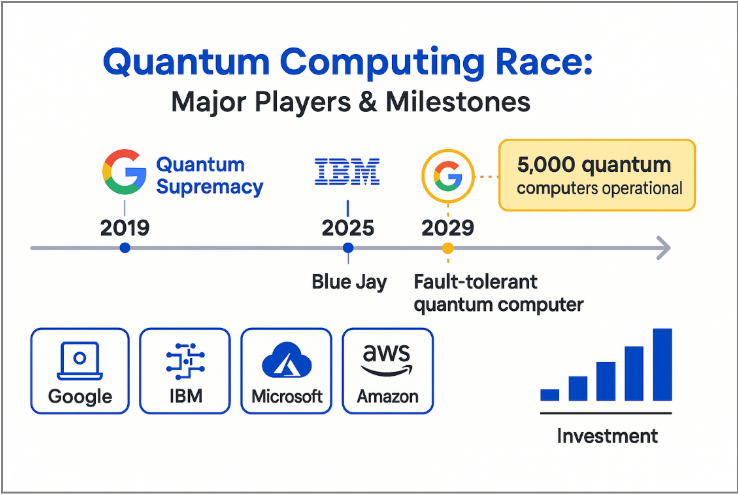
In 2019, Google announced it had achieved quantum supremacy meaning its quantum computer solved a problem faster than any known classical computer could. Though that specific problem wasn’t practical, it showed what’s possible.
In the near term, quantum computing is expected to provide value through hybrid approaches. This means that quantum computers could assist classical ones on specific problems like optimizing chemical reactions or simulating quantum systems.
Progress is steady, and quantum computers are likely to get more mainstream in the next decade. We could see further breakthroughs in terms of reliability, which would accelerate quantum computing drastically.
Leading companies in quantum computing
Quantum computing is one of the most exciting frontiers in technology. This has led to some of the biggest names in the world racing to lead the way. Many organizations are investing billions into building the first practical, large-scale quantum computers.
Each company has its own approach to solving quantum challenges, using different hardware and software strategies. Some companies are building their own quantum processors but others focus on cloud services that give researchers and developers access to quantum machines remotely. All of the investment is likely to speed up the development.
Google and the Willow chip
We’ve already explained how Google claimed to have achieved quantum supremacy using its Sycamore chip, solving a problem in 200 seconds that would take a supercomputer thousands of years. Since then, Google has been working toward building a fault-tolerant quantum computer that can handle real-world problems. Its current goal is to achieve a useful, error-corrected quantum computer by 2029.
Google’s latest quantum chip is called Willow. Willow improves upon earlier designs with better qubit performance and stronger error correction. It’s part of Google’s ambitious plan toward scaling up quantum hardware to the thousands or millions of qubits needed for practical quantum advantage, which means the point at which a quantum computer is able to solve a problem faster or more efficiently than a so-called classical computer.
Google also actively collaborates with academic partners and open-sources some of its quantum tools. This has the potential to expand the broader quantum ecosystem.
IBM and superconducting qubits
IBM is one of the most established companies in quantum computing. It has been working on quantum technology for decades and was one of the first to offer cloud-based access to quantum computers through its IBM Quantum platform.
IBM’s approach relies on superconducting qubits, which are circuits cooled to near absolute zero to display quantum behavior. The company’s quantum roadmap includes a plan to scale from current devices to 2,000-qubit systems, with the next big chip called Blue Jay. It is expected to be operational by 2029.
It is already possible for corporate partners to run quantum experiments and applications on real IBM hardware through the cloud. IBM is also heavily involved in quantum software development, helping to grow a suite of tools and open-source platforms like Qiskit.
Microsoft and Azure Quantum
Microsoft is taking a unique approach to quantum computing. The company is focusing on both hardware innovation and building a comprehensive quantum software stack. Azure Quantum is their cloud platform. It allows users to run quantum algorithms on various types of hardware through partnerships with multiple quantum companies.
Rather than building just one kind of quantum computer, Microsoft gives developers access to machines from companies like IonQ, Quantinuum, and Rigetti. This is done through Azure’s cloud interface.
Microsoft is also investing heavily in topological qubits. This is a novel approach that could one day lead to more stable and error-resistant quantum computers. This technology is still in development, but Microsoft’s strong software-first strategy and hybrid quantum-classical tools make it a key player in helping businesses explore quantum potential.
Azure Quantum also provides powerful tools for quantum algorithm development. It could make it easier for scientists and developers to write code that could eventually run on future quantum hardware.
Amazon and Braket
Amazon’s entry into quantum computing is available through its AWS cloud platform. Amazon Braket gives users the ability to test quantum algorithms on real quantum hardware from multiple partners, without having to build their own quantum computers.
Through Braket, users can run simulations and experiments on hardware from companies including IonQ and Oxford Quantum Circuits. This allows researchers and developers to explore quantum possibilities today.
Amazon’s goal is to foster innovation and experimentation while providing developer-friendly tools to support the emerging quantum ecosystem. Amazon is also betting that cloud access to diverse hardware will accelerate progress across the quantum field.
Notable startups and research labs
Some of the most exciting innovation in quantum computing is coming from startups and research labs around the world.
- Rigetti. A pioneer in superconducting qubit systems. Rigetti offers cloud-based quantum computing and is developing increasingly powerful chips.
- IonQ. Uses trapped-ion technology. This offers high accuracy and long coherence times. IonQ is already a key partner for cloud platforms like AWS and Azure.
- Xanadu. Specializes in photonic quantum computing, which uses light instead of supercooled metals. This potentially offers more scalable and room-temperature quantum solutions.
Many universities and national labs (including MIT and Caltech) are making their own contributions to quantum science. Universities often work closely with both big tech and startups.
What’s possible today with quantum computers?
Today’s quantum computers are still in the early experimental stage. They’re not yet ready to replace classical computers or tackle the world’s biggest problems. However, they’re already being used for research and proof-of-concept experiments.
The aforementioned cloud-based services give researchers and developers access to real quantum processors for testing new quantum algorithms and exploring what quantum systems can do.
So far, quantum computers have been used to:
- Simulate small molecules and chemical reactions
- Explore new materials at the quantum level
- Optimize small logistics problems
- Study other quantum phenomena like entanglement and interference
- Advance research in quantum cryptography
Today’s machines are still limited in size and reliability. They often handle only a few hundred qubits with relatively high error rates. This means they can’t yet outperform classical supercomputers on most real-world tasks. Quantum computers are primarily a research tool for now.
What’s coming next
The next few years will bring major advances in quantum computing. Companies and researchers are focusing on several key areas. One big challenge is increasing the number of reliable qubits while maintaining their quality. Companies are working to scale up their quantum processors from hundreds to thousands (and eventually millions) of qubits.
Researchers are developing new techniques to tackle the problem of stability. A key breakthrough will be when we have a better way to stabilize qubits and correct errors automatically during computations.
Most experts predict that in 5 to 10 years, we’ll begin to see practical quantum advantage, where quantum computers outperform classical ones in specific, valuable applications.
As hardware improves, quantum computers will start to deliver real-world value in industries like:
- Pharmaceuticals. Simulating molecules to design new drugs
- Materials science. Discovering new materials with unique properties
- Finance. Optimizing investment strategies and risk analysis
- Logistics. Solving complex routing and supply chain problems
Challenges and limitations
Despite their promise, quantum computers face major challenges and limitations today.
As discussed, qubits are fragile and error-prone and this problem is known as decoherence. This makes it difficult to perform long, reliable computations.
The systems need isolation from vibrations and electromagnetic shielding. Building and maintaining these systems is complex and expensive. It is not something that can be easily scaled.
In terms of raw power, today’s quantum machines are still limited. For everyday tasks like word processing or spreadsheets, a regular laptop is far more practical. Quantum computers aren’t designed to replace traditional devices for everyday tasks, and probably never will.
Overcoming these challenges will take years of research, but the potential rewards make it a race worth running.
Why it matters to you
Quantum computing isn’t just about theoretical science or big tech companies competing for headlines. It’s a technology that could quietly transform the world around you. The future of quantum computing will impact everybody.
We’ve already briefly touched on the fact that quantum computing could help discover new drugs and treatments for diseases faster than ever before. Researchers can predict how new drugs will interact with the human body by examining and simulating them on a quantum level. This has the potential to speedup clinical trials and reduce costs. This could lead to breakthroughs in treating diseases that have been a problem throughout human history.
It also holds promise for solving complex energy and climate challenges. Quantum simulations could help us design better batteries and improve the efficiency of solar cells. It also allows scientists to model large-scale climate systems more accurately and could open doors. These could be powerful new tools in the fight against climate change.
Another area where quantum computing will have a direct impact on your life is cybersecurity. Many of today’s most widely used encryption methods. These are the algorithms that protect your bank accounts, personal messages, and data. They rely on mathematical problems that classical computers struggle to solve.
A sufficiently powerful quantum computer could break these codes in minutes. This is why researchers are now racing to develop quantum-safe encryption that can withstand the capabilities of future quantum machines.
At the same time, quantum computing may also enable stronger forms of encryption. Techniques like quantum key distribution (QKD) could make it possible to create communication channels that are virtually unhackable under current assumptions and ensures the privacy of sensitive data for decades to come.
In the right hands, quantum computing makes us safer. In the wrong hands, it could be a serious danger.
Even if you never directly use a quantum computer, the industries you rely on will all be touched by its capabilities. In short: quantum computing could reshape the foundation of the digital world you interact with every day.
Related articles:
How does machine learning enhance cybersecurity measures?
How does artificial intelligence impact cybersecurity measures?
How does blockchain enhance security and transparency in transactions?
How do AI search engines enhance user experience and safety?
What are the main advantages of using cloud computing services?